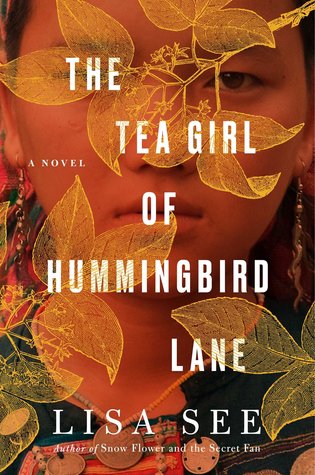
 Since I am forever on the search for historical fiction that is not about World War II, I was thrilled to come across The Tea Girl of Hummingbird Lane by Lisa See. Not only is it not set during WWII, but it set during my lifetime, which initially made me hesitant to put it under the historical fiction label. But because of the story it tells, and the way it is told, that label seems both appropriate and fitting.
The Situation: Li-yan grew up in a remote Chinese mountain village among the Akha people. She did not grow up wealthy or well-connected, and her culture prized sons above daughters, sees the birth of twins as a tragedy that requires a thorough and severe cleansing ritual, and what little money they make during the year relies heavily on how much tea they can pick and process to be sold. As the only daughter in her family, Li-yan will inherit the private tea grove that has been passed down the female line in her family. It is so private that no man is allowed to enter it, for it is believed that if he does he will die. The tea made from the trees in this grove is thought to be the best in the world, and not just by Li-yan and her mother. If Li-yan follows her culture's traditions, as well as her mother's footsteps, she will grow up to be village's next mid-wife and healer. But Li-yan wants more for her life, especially as she learns that the world outside of her small village is changing rapidly.
The Problem: The trouble starts when Li-yan falls for a boy her parents do not approve of. San-pa is known to be lazy and a troublemaker, but Li-yan insists she loves him and wants to marry no one else. When San-pa leaves the small village to work hard so he can return and gain Li-yan's parents' approval, she finds that she is pregnant with his child. A child born out of wedlock is considered a human reject that must be killed immediately after birth, but instead of following the tradition she grew up with, Li-yan manages to have her baby dropped off at an orphanage, where the little girl is eventually adopted by an American couple. It is an action that will bring Li-yan much relief and sorrow, as she will spend much of her energy both grieving over the daughter she lost, as well looking for her in the face in every Chinese girl she sees. Both women must move forward with their lives, one wondering about the daughter she gave up, and another wondering about the mother who would give her away, and if there is any way to find her.
Genre, Themes, History: This is a historical fiction novel that is actually set in the not at all distant past. Starting in 1988 and going all the way to 2016, the story begins with Li-yan's childhood and continues until she is an adult living in California, far away from her small mountain village in China. She will come a long way from her incredibly humble beginnings as an apprentice mid-wife to her mother. Possibly the one thing that will always have a presence in every chapter of her life is tea. Her family picked it and sorted the leaves as their primary source of income. And after attending a trade school, she will then be accepted into programs that will help her build upon the knowledge she already has, allowing her to eventually open her own tea shop and join the modern world outside of her village. As Li-yan gains more education, and sees more of the outside world, it becomes increasingly difficult for her to reconcile the Akha beliefs and traditions she grew up with, and what she observes in the world outside of her village. The book also delves into China's history with communism, the one-child-policy, and of course, the tea trade. And while the majority of the book is told in first-person through Li-yan, there are small sections that include information about Haley, the daughter that Li-yan gave up. Whether through letters, school assignments, or group therapy transcripts, little bits of information about Haley's life are given to the reader, which show a young girl struggling with her identity as a Chinese girl with white adoptive parents.
My Verdict: This is an incredible story and a spectacular way to talk about the history of the tea trade and industry in China. Through Li-yan, the reader learns a great deal about tea: how and when it is picked, sorted, processed, packaged, sold, and even brewed, down to the best type of water to use when doing so. For the most part, the characters are fully developed and become real people dealing with issues most anyone can relate to, such as family expectations and obligations, and the desire to protect what is precious from those who wish to possess it for their own profit. My only issue with this book is its pacing. Sometimes the story moves at a steady pace, and at other times it moves quickly, even through settings or scenarios that would seem important to overall story development, but instead end up coming across as more of a means to an end, if that makes any sense. I also wish more time was spent learning about Haley and what her life is like with her adoptive parents in California. Otherwise, this is a great book that I still believe would be suitable for fans of historical fiction, despite it taking place during the late 20th/early 21st centuries.
Favorite Moment: When Li-yan finally realizes the truth about the man she married.
Favorite Character: Li-yan's mother, or A-ma, is a proud and often stubborn woman, but she is also respected and has done much to earn that respect throughout her community. Like many mothers, she knows more than she lets on, causing Li-yan to have revelations later in her life about events that happened decades before. She may be committed to her culture's beliefs and traditions, but her commitment to her daughter will ultimately come first.
Recommended Reading: Lucky Boy by Shanthi Sekaran is a different kind of story that also deals with the adoption of an immigrant child by parents that do not share his ethnic background.
 At long last, I have finally come around to reading and posting about Paula Hawkins' second novel, Into the Water. Her first thriller, The Girl on the Train, delighted (and also troubled) many and was eventually made into a movie. I was already made aware that her follow-up, while not quite like the first one, was also a thrilling mystery that may keep the reader guessing.
The Situation: When Nel Abbott's body is found in the river, the reaction to the news is mixed. For some, the news comes as a relief, mixed in with a little joy if some are honest. For others it is distressing. And for still others, it is a little bit of both. Understandably, Nel's 15 year-old daughter Lena is distraught and finds reason to be angry with nearly everyone, including herself. A good amount of her wrath is focused on Jules, Nel's estranged sister, who is now being dragged back to the one place she never wanted to see again. Upon returning, she learns that her sister was not well-liked in the small community, mostly because of her work and research into what she called The Drowning Pool. It seems the river has a history of claiming the lives of "troublesome" women, with Nel being the most recent addition. Now Jules, as well as nearly everyone else in town, must once again confront their own history and what they are each capable of and responsible for.
The Problem: Dealing with a sister's death, even an estranged one, is difficult enough. But Jules finds herself having to deal with the death that occurred before Nel's as well. It seems a friend of Lena's also committed suicide at the river, something that Nel was blamed for by the girl's mother. While that investigation has been closed for some time, it seems that Nel's death has served to bring new evidence, as well as old emotions and old stories. Not everyone in town believes that Nel killed herself, or that the whole story was told concerning the other deaths at the river. There are even a few who believe the person responsible is still a threat, and the women in town are still in danger. But it seems everyone is hiding something, and almost anyone connected to the women who died feel some amount of pain or grief, whether they are actually guilty or not.
Genre, Themes, History: This is a fiction novel set in present day in a small town in England. If there was one main character it would be Jules, the sister of the most recent woman to die at the river. But there is also the daughter, Lena, who is now grieving the loss of her mother, while also having not gotten over the death of her best friend, Katie. There are many other slightly less prominent characters, though still important, such as Sean Townsend, the lead investigator into Nel's death, as well as his wife, Helen, and father, Patrick. The local psychic, Nickie, claims to know things, and also commune with the dead, but mostly she gets on people's nerves as they do not believe her. And when it seems she does have something helpful to offer, she is cryptic and vague, causing most people to give up on her. The story switches between the points of view of nearly everyone involved, allowing the reader to get a glimpse into why people do what they do and say what they say, especially in times of tragedy. This town has a history it would rather ignore, and perhaps that is why it keeps repeating itself.
My Verdict: While this is a good story, it is not necessarily a good mystery. It is fairly easy to see in what direction this book is headed as soon as it is understood that Nel Abbott was not a well-liked person. And after reading at least one chapter from the point of view of each key player, it was easy to know what actually happened and who is responsible. The mystery part just was not there for me. And while the character development may have been on point, their relationships with each other were often hard to believe. In the end, there were more than a few loose ends that were not properly tied up, at least in my opinion, and the big reveal did not feel that big. There were many missed opportunities that would have made this book a bigger page turner than its predecessor, but something just was not there. Many details seemed tacked on, as if they were an afterthought. If anything, the one motivation the reader has to keep turning the page is to see if justice is brought to the right person, or at least to the characters that we do not like.
Favorite Moment: When Louise, Katie's mother, was forced to the realization that she did not really know her daughter.
Favorite Character: There was not one character in this book that did not aggravate me in some way, but in the end I will pick Jules for gathering the strength to return to this community and confront her own mistakes.
Recommended Reading: The Girl on the Train is much more suspenseful and certainly worth the anxiety that comes from reading such a disturbing story.
 The full title of today's selection is The Radium Girls: The Dark Story of America's Shining Women. In it, Kate Moore tells the true story of the women who worked as dial-painters in America during World War I. It was a somewhat prestigious, well-paying, and often fun job for young women in the early 1900s. The book is full of stories of the girls getting along well with each other as they sat at their stations and painted tray after tray of dials using a paint mixture made from radium. Of course, those of us living in the 21st century are well aware of the dangers that can come from being exposed to radium, even to a small amount for a short period time. But during WWI, radium was still being hailed as a miracle substance that was perfectly safe to be around, though there are some people who knew the truth.
Genre, Themes, History: This is a nonfiction book that gives detailed accounts of the lives of several women who worked as dial-painters in early 20th century America. These women went to work in one of two cities, either Orange, New Jersey or Ottawa, Illinois, in factories that specialized in the production of clock faces painted with the mysterious and glowing substance of radium. They had been told the substance was safe, so there were little to no safety precautions in place to protect the girls' health. In fact, they were told it was so safe that the technique of lip pointing was employed to make sure the brushes they used achieved the perfect fine-pointed tip. Basically, to keep the hairs of the brush from spreading, which would make them unable to achieve the fine lines necessary for dial-painting, the girls would put the brushes in their mouths before dipping them into the paint. And because radium often made the hairs on the brushes stiff and hard to work with, the girls would put them in their mouths several times throughout their shift. Although the regular exposure to the radium would be enough to cause problems, the fact that the girls were putting the radium covered brushes into their mouths led to serious health concerns that many of them would never recover from. Most often the substance attacked their mouths and jaws, often moving to bones and joints throughout their body. As more and more women fell sick, and people were finally realizing why, the women would not only fight for their lives, but also against the companies that helped put them in this terrible position. Cases that came out of both Orange and Ottawa would set precedents regarding worker's rights and holding companies accountable for occupational hazards.
My Verdict: There are other books and articles that talk about the dial-painters of America and what they went through as a result of the work they did, but what Moore wanted to do was write a book that told a story specifically from the women's point of view, and I think that is what makes this book so interesting and engaging. It does not simply list facts and figures, names and dates, court cases and cities. Instead, Moore goes into the women's daily responsibilities as dial-painters, who they married, how they lived, what their hometowns were like, and later, how each one suffered, what treatments they endured, how they found a lawyer (if they found one at all), and ultimately how they died. Though it is a true story, it does not read like one, and often felt more like political intrigue or a courtroom drama. But these were real people who endured real suffering, and had to fight real corporations who were more interested in making money than in keeping their workers safe. It is an interesting story that was often hard to read, but ultimately it was worth it to learn about a fascinating piece of American history.
Favorite Moment: When a high-profile lawyer from Chicago decides to take on the women's case for free.
Favorite Character: Grace Fryer was perhaps the most fierce of the group from Orange who decided to sue the United States Radium Corporation. She often led the charge when confronted with a new barrier and was never intimidated into backing down.
Recommended Reading: I recommend The Train to Crystal City by Jan Jarboe Russell, which tells the story of the only family internment camp in American during World War II.
 I love reviewing comic collections, mostly because they are the easiest thing for me to read and review, but also because they are so much fun. After reading Sarah Andersen's Adulthood is a Myth earlier this year, I could not wait until the second collection, Big Mushy Happy Lump, hit the bookstores.
Genre, Themes, History: Just like its predecessor, I placed this collection under the heading of graphic novel, though there is no one storyline to follow. However, unlike Adulthood is a Myth, near the end of the book, Andersen does include three short essays, providing illustration for them along the way. Once again, the book covers a variety of issues and scenarios that the introverted and creative among us would be able to relate to. My personal favorite from this category is "How to Become Good at Drawing," which is essentially a cycle of drawing, followed by self-loathing. I would say that oftentimes the same is true for becoming better at writing. Of course, the book also has many comics that deal with women's issues, such as being on vacation or traveling during that time of the month, and the ability (or inability rather) many men have of completing missing any and every social cue that lets them know a woman is completely, and utterly not interested in whatever they are offering. Andersen's rabbit sidekick friend does not make as many appearances in this one as he (she?) did in the previous one, but they are still there on occasion to make the snarky side comment or point out the obvious. And the three essays at the end deal with Andersen's inability to socialize, her adventures to becoming a cat lover, and her confession of being a sweater thief. None of them are terribly long, but they do give more insight into the woman behind the drawings.
My Verdict: Again, my one contention with this collection is that it is so short, though longer than the first one. I want to keep turning the pages, possibly for forever, and continue finding more comics to laugh at, laugh with, and generally relate to as a fellow introverted creative type. This is a fantastic follow-up to Adulthood is a Myth and continues the story, even without there being an actual narrative. Even if a comic touches on a topic Andersen has covered many times before, it is always done in a new way, from a new angle, or even with a different approach. If anything, it is a good collection to have for anyone who feels socially awkward, or tends to drown themselves in self-doubt or over thinking, as it is an excellent reminder that you are not alone, and there are many others like you.
Favorite Comic: "How I Spend Money" speaks to me on levels I am not entirely proud of, but are hilarious in comic form. It shows Andersen being quite frugal when it comes to groceries, clothes, and household items. But when it comes to buying books, she walks up to the counter in the bookstore wearing a fur coat and sunglasses, and proceeds to take the cash from her pockets and throw it in the air. Yep, accurate.
Recommended Reading: Naturally, you don't need to read Adulthood is a Myth before picking up Big Mushy Happy Lump, but why wouldn't you want to?
 A book that features an imagined dystopia in which the U.S. is going through another civil war? Um...okay, sure. As uncomfortable and unsettling as reading such a story can be, especially given our current political climate, I decided to go ahead and pick up American War by Omar El Akkad. It is another one that seemed to be making its rounds on Goodreads, so I gave in to my own curiosity.
The Situation: Sarat Chestnut once lived with her family in a house by the Mississippi Sea. The year was 2074 when her father left home in an attempt to secure the family a place in the north. The U.S. had just recently began fighting its second Civil War, but instead of slavery serving as the default reason for the disagreement between the north and the south, this time it was the use of fossil fuel. The states of Mississippi, Alabama, and Georgia make up the Free Southern States, while South Carolina remains a quarantine zone due to the outbreak of a deadly virus after a terrorist attack. With fighting so close to home in the Battles of East Texas, and the disappearance of her husband, Sarat's mother decides to move her family somewhere safer, somewhere they will be taken care of and provided for. It is in Camp Patience in the northern part of Mississippi where Sarat will spend the remainder of her adolescence, and where her life will continue on a path from which there will be no coming back.
The Problem: Of course, war is an ugly thing, no matter which side you are on. Camp Patience may provide relative safety, but it is still incredibly close to the Blue border. If that were not enough, there is also the tension between the Reds and the rebels, who are supposed to be on the same side, but cannot seem to get along. Sarat's fearlessness and independence sets her apart from the rest of the children in Camp Patience, bringing her to the attention of a mysterious and well-dressed foreigner. After a massacre kills of most of the residents of the camp, this foreigner will take this opportunity to turn Sarat into his own weapon, one that the Blues will never see coming. As the war goes on, Sarat becomes smarter, harder, tougher, and more vengeful. It is this thirst for vengeance that the mysterious outsider will feed on, while aiming to hurt more than just the opponents of the free southerners.
Genre, Themes, History: This is a novel that takes place mostly between the years 2074-2095, during the America's second Civil War. Told from the point of view of a third party, whose identity is not revealed until near the end of the book, it is the story of Sarat Chestnut, her family, and how she became an important and key figure in the war. It was tempting to label this book as science fiction since it is set in the future, but I decided against it as there is little beyond that to recommend it for that category. As the novel unfolds, Sarat will go from being a fairly typical happy and carefree child, to a hardened and dour teenager, to a vengeful soldier, a broken prisoner, and finally, a broken and nearly empty shell of a person. In between chapters, interviews and documents concerning the war are inserted, giving different angles and perspectives to the war that Sarat would never have, or even consider. It is the story of the potential journey one child can take when their country is at war. And while Sarat would like to imagine that she is making these decisions for herself - choosing her own destiny and for what and whom she would like to fight - and that her mysterious tutor sees something special in her, the truth is actually far less complimentary. Those who side with neither the north nor the south are fighting for their own interest, looking out for anyone willing to do their bidding under the guise of exacting their own justice. It is a story that Egyptian-born El Akkad would certainly be able to imagine and tell as an award-winning journalist who has covered stories from the war in Afghanistan, to the Black Lives Matter movement.
My Verdict: As I mentioned in the introduction, this book was uncomfortable to read at times. For one, while it is set in the future, it is not set all that far in the future. If any of this were to happen, it is plausible that people who are alive now in 2017 could potentially live to see it. Second, it is not a civil war occurring in some far off land that a citizen of the U.S. would have to take a plane to visit. States that we can drive to would be closing their borders against each other, and deploying troops to fight fellow citizens. Yeah, it's scary. And oftentimes, books that imagine a future where the U.S. has turned against itself feel like they are pointing a finger, but this one does not feel that way. It also does not feel like it takes sides. El Akkad takes an innocent girl and makes her the center of this story, and the unfortunate product of a problem she did nothing to create. The book could be taken as a warning, but ultimately, it is a story exploring the nasty effects of war.
Favorite Moment: When Sarat shaves her head after completing a dare that no other child would have had the courage to complete, but completing it will still earns her unending teasing and ridicule.
Favorite Character: There are none righteous here. Nope, not even one.
Recommended Reading: The only other books I have read that imagine the U.S. being broken up by war and fighting are from the the young adult genre. Both The Hunger Games and the Legend trilogies involve a country torn apart by in-fighting, with some areas suffering more than others.
 As part of a blog tour hosted by Reading Addiction Blog Tours, I agreed to read and review Grond: The Raven High by Yuri Hamaganov. The book promises to be the first in a series, exploring a world in the not too distant future where Earth's resources have run dry, feelings about and towards androids are tenuous, and we must find alternate methods of providing for the most basic of human needs in order to survive.
The Situation: In the year 2080, Olga Voronov is born and almost immediately sold to The Corporation. Her birth parents made a deal in exchange for money to have their daughter taken from them, raised by an android, and trained to manufacture advanced nanomaterials that will be used in an attempt to save Earth's sharply declining ecosystem. As one of seven bioengineered post-humans - also known as The Changed - Olga's mind works differently from that of a normal human, and by six years old she can already run complicated programs and simulations that aid in her training. At ten years old she will be declared fully mature and can work to earn her own money. Forced to live in isolation, she must remain at the High House, out in space but close to Earth, with only her android nanny, Arina, and all of the advanced technology she could ever want.
The Problem: Even with Olga's help, and the help of the other Changed beings, the earth continues to die, and the people on it continue to suffer. There are now only two classes of people: the very rich and the very poor. While Olga may know that the earth is in trouble, as that is the reason she exists, the full details of the horror are often kept from her. She laments the loss of Earth's oceans, as she dreamt of one day being able to swim in them for real, instead of in a simulation. But human suffering is of little concern to her, as she sees beings like herself as the next logical step in human evolution. But not everyone shares her view, and there are even some with the resources to reach her who would prefer she did not exist, and that humanity would be made to suffer the consequences of the world they have created.
Genre, Themes, History: This is a science fiction novel that begins in the year 2086, and continues until Olga reaches the age of 12, at which point she has the appearance of a fully grown adult woman. Earth is in such terrible shape that a new class of human beings were bioengineered in order to save it. However, the process seems to be slow going, and while human life continues on the surface, many people suffer, and unemployment remains incredibly high. Those that are wealthy enough can choose to practically live in virtually reality, perpetually ignoring that chaos and destruction around them. And the continents and countries as we know them today are all but erased due to war and famine. When the book opens, Olga is only six years old, but she is already extremely intelligent and The Corporation trains her hard. In many ways she is like a normal kid, as she loves hot chocolate, dreams of swimming in oceans with dolphins, and often neglects her homework in favor of video games. But her intelligence sets her apart. It also helps to make her cold towards the people she was born to help, but smart enough to realize that even she may not be immune to the chaos that is taking place below.
My Verdict: It is always difficult to enjoy a book where the protagonist is not likeable. And if her enemies are not sympathetic either, then who does the reader root for? Unless the story is incredibly inventive and captivating, the result is either profound indifference or annoyance, or perhaps both. Once I realized that Olga was not much interested in the plight of the human race - something that is only a natural result of her upbringing, intelligence, training, and extreme isolation - I stopped being interested in Olga. The future that Hamaganov created is, however, inventive and interesting. Earth's history from the year 2030 through Olga's birth is full of wars and fighting, as well as the controversial invention of androids. Of course, any alternate history (or future) that deals with conflicts between countries where there is a clear winner and a clear loser is going to anger and annoy some while delighting and amusing others, and the one presented here is no exception.
Favorite Moment: When Olga begins to realize that her situation and status is not as secure as she once wanted to believe.
Favorite Character: Everyone in this dystopian future has their faults, and they are all hiding something from someone. I even hesitate to pick Arina, Olga's android nanny who is nurturing and patient, while also firm and resolute.
Recommended Reading: Six Wakes by Mur Lafferty presents another version of Earth's future, but this one introduces cloning and the many moral and ethical questions that can come from it.
 I decided to tackle Paul Auster's 4 3 2 1 as my first fiction book after YA Fest, and I feel like I went directly into the deep end instead of wading through the shallow end first. Not only is this book a door stop, but it is also not something that I could imagine anyone lugging to the beach as a light read. If you are looking for a book that will take you some time and also require your full attention, 4 3 2 1 might be for you.
The Situation: Archibald Isaac Ferguson is born on March 3, 1947 to Rose and Stanly in Newark, New Jersey. He is a fairly ordinary Jewish boy, with a father who owns and works at his own appliance store, and a mother who enjoys taking portraits. But once the story of his birth is told, the novel splits into four different stories about four different Fergusons, as he is referred to. Each Ferguson has its own distinctive and independent path. Some characters outside of his parents will appear in all four stories, while others may only be in one or two. Sometimes his relationship with his father will be close, other times it will be strained. In one story, basketball will be his sport of choice, while in the rest, baseball will be his first love. The only thing that all four stories is guaranteed to have in common is that Ferguson is at the center of them.
The Problem: Playing the what if game does not always mean that the possible outcomes will be positive. Because all four Fergusons had their life begin in 1947, that means that their adolescents must take place in America during the tumultuous 1960s. Each Ferguson will have its own thoughts and feelings and reactions during a time when it may seem like the country is ready to tear itself apart. But often, the events that are happening within Ferguson's own family are enough to keep him busy. In every story, Ferguson's uncles are not the best people in the world, but how they affect his family, particularly his father, depends greatly on how Stanley handles them. The outcome of other events seems to depend little on the actions that precede them, but instead they come out differently only because a different story is being told. Each Ferguson has his own problems, struggles, and hangups. But each Ferguson also has his own friends, ambitions, joys, triumphs, and desires.
Genre, Themes, History: This is a contemporary fiction novel that could really be considered as four different novels, all about the same person. It is tempting to add the heading of historical fiction to this novel, as there is much detail concerning historical events in each story, and how they affected Ferguson and his simple life in New Jersey. Probably the event that dominates most of the novel, especially as Ferguson leaves high school and enters college, is the war in Vietnam, and the tensions it set off on our own soil. Every part of Ferguson's life, in all four stories, receives a fair amount of attention. But because the Vietnam War is gaining traction right at the crucial moment when the Fergusons are approaching adulthood, it is the event that dominates the latter half of the novel. But beyond the historical aspect of the novel is the ambitious approach it takes to telling the story of Ferguson's life. Each Ferguson is different from the next, which even means some are more likeable then others. One Ferguson might be relatable and sympathetic, while another may be hard to read about, and still another may not be as interesting to read about, though a perfectly nice person. The stories begin the moment Ferguson is born, and continue until the fourth one graduates college, though not all of them are granted that luxury. The novel is a study in how different our lives could be if one minor detail were changed, or if fate simply decided to do things a little differently. And *spoiler alert* the title is somewhat of a countdown clock: As the novel continues, the Fergusons die off one by one, until only one is left and is revealed to be the real story.
My Verdict: First things first: This book is long, like Infinite Jest long. But given that the novel is really four novels in one, I suppose 800+ pages is not too much to ask for from the reader. I am always drawn to a book with interweaving narratives. While the characters in each story do not necessarily cross paths with the characters in others, it is interesting to see where different people show up in the four Fergusons' lives. And of course, it is just interesting to see what happens to each Ferguson and where he ends up. If I had an issue with the novel, it would be that it often gets lost or gets a little too deep into the historical context. Or that it will often take too much time in exploring every small detail that leads up to a momentous event or decision in Ferguson's life. I appreciate knowing every minor thing that led to Ferguson doing something, but often I would rather just get on with the event and move on with the rest of the story. But the four different stories are not simply an excuse to write four different novels and put it in between the covers of one. Auster manages to bring them all together in the end and also makes it clear that 4 3 2 1 is not just four different stories, but four lives of one person.
Favorite Moment: A well-placed blank page is a powerful thing, even when you know it is coming.
Favorite Character: Ferguson's mother Rose is more or less the one constant through all four narratives, which is probably a statement about her and her steadfast nature, as well as just how important she is in the young man's life.
Recommended Reading: Life After Life by Kate Atkinson takes the one life, many stories idea, but does it a little differently. Instead of having one life split into many, Atkinson's protagonist keeps reliving the same life, but different choices lead to different outcomes.
 Since I am forever on the search for historical fiction that is not about World War II, I was thrilled to come across The Tea Girl of Hummingbird Lane by Lisa See. Not only is it not set during WWII, but it set during my lifetime, which initially made me hesitant to put it under the historical fiction label. But because of the story it tells, and the way it is told, that label seems both appropriate and fitting.


